2027 ATHENS
API FORUM CONFERENCE
> Introduction
> Call for Papers
> Registration
> Program
> Plenaries
> Workshop Sessions
> Presentations
> Poster Sessions
Towards plurilingual, action-oriented language education:
Fostering teacher and learner agency
2ⁿᵈ API Education Conference
National and Kapodistrian University of Athens
24-25 June 2027
Call for Papers:
Proposals are invited for presentations and posters. Presentations will be limited to 20 minutes (15 minutes presentation + 5 minutes discussion). If you would like to make a proposal for a presentation or poster, please upload by 14 December to this link a title, 100-word Bio and 150-word abstract.
In submitting your abstract, please consider the themes of the conference on the Introduction page.
All necessary information is given in the Call for Papers document. Notice of acceptance will be sent (via email to the first presenter) by 31 January.
Please note: Registration is not yet open, and you will need to pay both your 2027 membership fees and the conference fees when you register.

Call for Papers document
In a world that seems increasingly marked by tensions and xenophobia, plurilingual and intercultural education together with protection of fundamental human rights like language rights have become critical. Action-oriented, plurilingual and inter/pluricultural education promotes inclusivity, openness and social justice in a holistic approach to language education. It promotes a coherent approach to language across the curriculum from the language of schooling to all other languages – home language(s), minority languages and additional languages – encouraging teachers and learners to value linguistic and cultural diversity as educational enrichment. Research increasingly supports a complex vision of language education highlighting the fluid and socially constructed nature of language, the learning process and the role of learners in the class. Meanwhile educational practices are embracing innovative approaches that make space for learners’ agency by accepting such complexity rather than aiming for simplification and linearity, and see linguistic and cultural diversity as an opportunity on which to build a mediated collaborative and personally meaningful education.
API Education Forum, an international community of academics, teachers, teacher educators, curriculum developers, administrators, and policy makers from over 25 different countries, aligns itself with this new dynamic vision and fosters exchange and synergies between scholarly research, educational practice and language policies. The main mission of the Forum is the promotion of action- oriented, plurilingual and intercultural (API) education to help further inclusive societies that provide quality education and social justice for all.
Following API Forum’s successful launching conference in Rome in 2025, we are excited to announce that the 2nd API Education Conference, Towards plurilingual, action-oriented language education: Fostering teacher and learner agency will be hosted by the Research Institute for Multilingualism and Language Policy at the National and Kapodistrian University of Athens, on June 24-25.
The conference will provide the opportunities for scholars, students and practitioners to share presentations on aspects of action-oriented plurilingual and intercultural education as well as state-of-the art relevant recent and forthcoming research, projects and publications. The API Conference will enable researchers, practitioners and language stakeholders to critically reflect on current developments in the field of language education and on promising educational practices while encouraging reciprocal relationships and the creation of synergies between research and practice in the supportive environment of a growing community. The conference will be in hybrid format (in person/online) to encourage different forms of participation.
We invite you to submit contributions for presentations and posters in which participants will discuss new avenues of research and practice, including the following themes:
-
-
- Plurilingual and intercultural education across educational contexts
- Designing and implementing plurilingual education programmes in school and higher education
- Using CEFR descriptors for plurilingual curriculum design and assessment
- Inclusive language education policies and practices
- CEFR-informed classroom practices, e.g., scenario design and continuous assessment
- Valuing learners’ linguistic and cultural repertoires
- Supporting languages of origin and heritage languages in education
- Teacher education for plurilingual and action-oriented pedagogy
- Teachers plurilingual repertoires and classroom practice
- Teachers’ and learners’ agency in plurilingual learning environments
- Innovative practices in action-oriented language teaching and assessment
- Mediation,
- Intercomprehension and cross-linguistic practices in teaching and assessment
- CLIL and plurilingual, action-oriented approaches
- Plurilingualism in minority language and bilingual education contexts
- Plurilingualism for decolonization and social justice in language education
- Plurilingualism, digital technologies and AI in language education
In this plurilingual conference, there will be presentations in languages other than English and speakers will be urged to use more than one language (e.g. presenting in English and having their PowerPoint in another language or vice-versa). There will also be discussion groups in different languages.With its diverse programme featuring plenary sessions, presentations, roundtable discussions, poster sessions, and social events, the API Conference offers a unique opportunity for scholars, graduate students, practitioners and other stakeholders engaged in language education from all over the world to connect, share insights, and discuss their research. It also serves as a platform for participants to establish and expand academic networking for future collaborations.
Please note: Registration is not yet open and you will need to pay both your 2027 membership fees and the conference fees when you register.
-
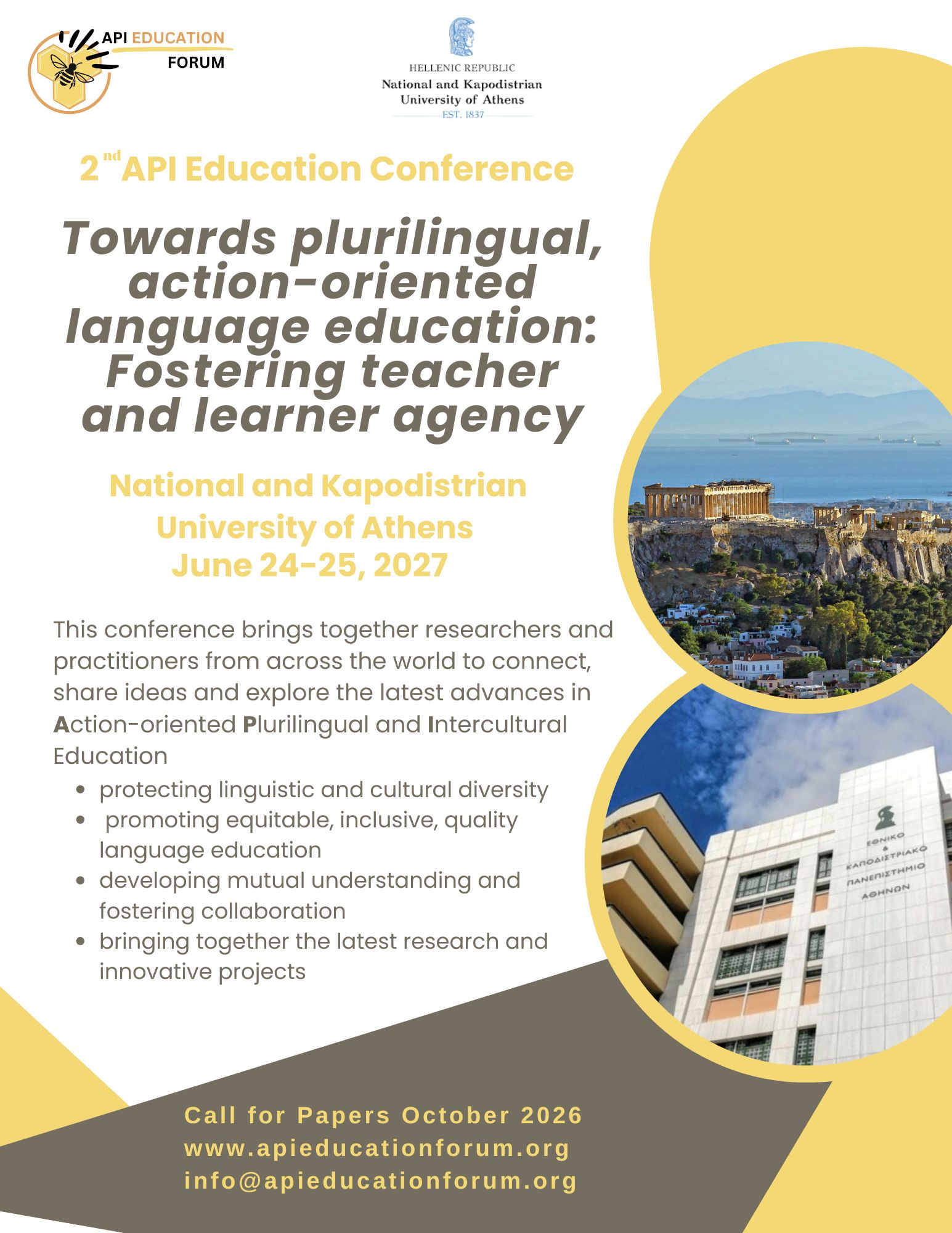
Flyer
Plenaries

Plurlingual Education from a Neurolinguistic and Cognitive Perspective: Cross-Language Interaction and the Role of Language Awareness
Studies on plurilingual education emphasize the importance of cross-linguistic comparisons and metalinguistic reflection as key factors for progress in foreign language learning (Hufeisen & Jessner, 2019; Woll & Paquet 2025). To effectively design curricula based on language comparison and language awareness, it is crucial to gain insights into the cognitive processes associated with the use of the plurilingual repertoire (Riehl 2021). This presentation therefore explores the neurolinguistic and cognitive foundations, particularly the internal interconnection of languages and the development of metalinguistic knowledge.
First, neurolinguistic studies are presented that show how languages are interconnected. Then psycholinguistic evidence is provided to demonstrate the parallel activation of linguistic representations as well as the role of formal and semantic similarity in retrieval and processing (Riehl 2021). In the second part of the paper, the concept of language awareness will be addressed. In this context, an intercomprehension study will be presented that examines how speakers of different languages utilize their plurilingual resources across various language families. This study shows that speakers who use and compare all their languages and dialects— regardless of their affiliation with a particular language family—are the most successful at text comprehension. This underscores the role of cross-linguistic and metalinguistic awareness (Hufeisen & Jessner, 2019) as a central driving force in plurilingual pedagogical approaches.
Hufeisen, B., & Jessner, U. (2019). The Psycholinguistics of Multiple Language Learning and Teaching. In D. Singleton & L. Aronin (Eds.), Twelve Lectures on Multilingualism (pp. 65-100). Multilingual Matters.
Riehl, C.M. 2021. Neuroscience and plurilingual education: Trends for a research agenda. In E. Piccardo, A. Germain Rutherford, & G. Lawrence (Eds.), The Routledge Handbook of Plurilingual Language Education (pp. 175–190). Routledge.
Woll, N./Paquet, P.-L. (2025). Developing crosslinguistic awareness through plurilingual consciousness-raising tasks. Language Teaching Research, 29 (1), 63-87.
Claudia Maria Riehl is professor for German Linguistics and German as a Foreign Language. She is chair of the Institute of German as a Foreign Language and director of the International Research Unit of Multilingualism (IFM) at the Ludwig-Maximilians-Universität München. Her research interests are psycholinguistic and cognitive aspects of multilingualism, language contact, heritage languages, multiliteracy, and second language teaching. Professor Riehl is the author of many titles, among them German-speaking introductions into multilingualism and multilingualism research, language contact and migration linguistics. Recently, she published an overview of “German as a Heritage Language: Contact – Variation – Maintenance” (Cambridge 2026).

Bessie Dendrinos, President of the European organisation ECSPM (ecspm.org), is Professor Emerita and Director of the Research Institute for Multilingualism and Language Policy at the NKUA. She researches and publishes in English and Greek on language education policy and politics, language pedagogy, language testing and assessment, and multi-and plurilingualism in education. Her work has also appeared in Spanish, French and Portuguese. She has been responsible for the major foreign language curricula reforms in Greece, and has been head of the board of the multilingual examination suite that leads to the State Certificate of Language Proficiency, known by its Greek acronym KPG. As of this coming year, students in their last year of compulsory schooling are invited to take part in the e-KPG, which includes automated services and computer-adaptive testing.

The e-KPG Project: Mediation Test Task Typology & Assessment Criteria
The endeavor presented in this talk forms part of the work undertaken by experts involved in the KPG proficiency testing system—the Greek national suite of foreign language examinations—within a project funded by the Hellenic Ministry of Education (2026–2030). The plan is to establish the infrastructure and procedures required for computer-based examinations and the automated administration of the electronic KPG (e-KPG). A pilot phase of exclusively computer-based examinations will take place in 2026–2027, while from 2027–2028 all students in their final year of lower secondary education (ISCED 2) will have the opportunity to take the exams, free of charge, in one of the foreign languages they study at school.
The first part of the talk focuses on the mediation task typology developed for KPG examinations in English, French, German, Italian, Spanish, and Turkish, and currently being further refined within the e-KPG project. The typology distinguishes between cross-linguistic and intralinguistic mediation tasks and considers the range of competences and processes they elicit, including interlinguistic and intercultural awareness, knowledge, skills, and strategic resource use. It thus provides a basis for examining how different task types operationalise mediation and engage learners’ plurilingual and pluricultural repertoires.
The second part addresses the assessment of cross-linguistic mediation, drawing on an assessment framework developed with experienced raters and refined collaboratively by KPG language-testing experts. The framework includes criteria for written and oral mediation, such as content accuracy and relevance, information selection and organisation, appropriacy of reformulation, clarity and coherence, adaptation to the recipient, linguistic resources, communicative purpose, and intercultural appropriacy.
By linking task design and assessment, the talk explores how mediation can be operationalised and assessed while preserving its inherently dynamic, plurilingual, and intercultural nature, and considers the challenges of translating this multidimensional construct into valid and meaningful assessment practices for large-scale examinations.
Evdokia (Kia) Karavas is Professor of Applied Linguistics at the Department of English Language and Literature, deputy director of the Research Centre for Language Teaching, Testing and Assessment, co-coordinator of the Pedagogical and Teaching Competence Programme and of the “Teaching Practice in School I & II programmes”, as well as a member of the scientific committee of the Research Centre for Multilingualism and Language Policy – all at the NKUA. Her research and publications are on foreign language education, the development and evaluation of educational programmes and the training of foreign language teachers. She is on the board of the national foreign language exams known as KPG and responsible for the training of examiners and script raters. In the new e-KPG project she is also project manager for the NKUA.